
PREHISTORIC Stealth Guide: When to Sneak, Walk, Sprint or Freeze
How to move around PREHISTORIC's nights without being heard or seen: read the SOUND meter, follow the broadcast rules, and know exactly when to freeze.
Quick answer
Move slowly or sneak by default, sprint only when nothing is tracking you, and freeze completely the moment an animal sees or hears you. PREHISTORIC's animals hunt by sound, light and movement, so quiet movement is how you reach 6 AM.
- Watch the SOUND meter on the right side of the HUD and keep your movement in the soft range.
- When a broadcast reports a sound-hunting animal, move slowly and never run inside your home.
- If an animal is looking through the glass or listening through the ceiling, do not move and make no sound.
- If something is already inside the house, hide immediately with E and stay silent until it leaves.
Why movement decides the night
Every PREHISTORIC night runs from 12:00 AM to 6:00 AM, and winning is simply reaching sunrise — survive to 6 AM and the SUNRISE screen confirms you made it through. The official page is blunt about what stands between you and morning: "They hunt by sound. They hunt by light. They hunt in packs. Hide when they get in, stay quiet, and make it to sunrise."
That single fact drives every movement rule below. Anything that makes noise or light tells the animals where you are, and the emergency broadcasts during a night tell you which sense the nearby animal is actually using. The curfew broadcast frames the baseline: stay inside your home, keep lights away from windows, and close curtains and lock doors — "If you can see them through the glass, they can see you."
The controls that matter for stealth
- Sneak — C: your quiet-movement key
- Sprint — Shift: fast, but loud
- Flashlight — F: useful in the dark, but light draws hunters
- Flare — R: a situational decoy, covered below
- Interact / Hide — E: also how you enter hiding spots
- Lock Doors / Board Windows — Q
Sneak and Sprint are the two ends of your movement range. Hide (E) is what you switch to when moving stops being safe, and the flare is not a general-purpose trick — its use is tied to specific broadcasts, as explained below.
The SOUND meter is your movement gauge
The right side of the HUD carries a SOUND meter with three states — SOFT, NOISY and BREAKING — and it updates in real time as you move. "You can see your sound on the right side. When you run, you make noise." That makes the meter the practical answer to "how fast can I go right now": walk, glance at the meter, and slow down if the reading climbs. Treat NOISY as a warning that anything listening nearby can hear you.
The house can also make noise without your help. Early in Night 1, a red alert orders "Shut off the smoke alarm upstairs" — interacting with the smoke alarm shows [E] PULL THE BATTERY, which silences it. Quiet movement is only half of staying unheard; a blaring household noise source can undo it, so handle those alerts the moment they appear.
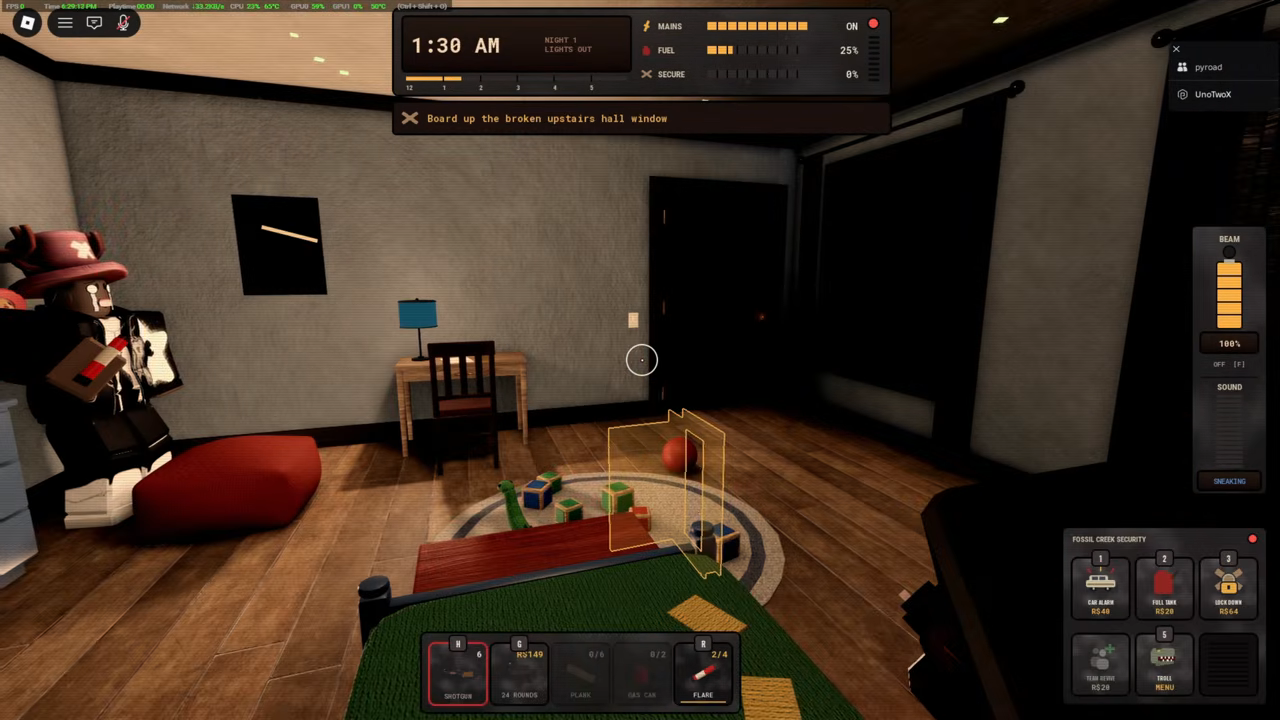
When to sneak, walk, sprint or freeze
Decision guide
Walking slowly is the default. The Night 1 broadcast for the large animal on the main road is the model for every sound-hunter: "MOVE SLOWLY. DO NOT RUN INSIDE YOUR HOME." Slow movement keeps your sound reading low while still getting you to the generator, the planks and the doors you need to lock.
Sneak (C) buys margin. When an animal is close, or you are crossing a room while a broadcast is still active, use the dedicated sneak key — it exists for exactly these stretches of the night.
Sprint (Shift) is an emergency tool, not a travel mode. Running pushes your sound up the meter, and the broadcasts specifically forbid running inside your home while a sound-hunting animal is reported. Save sprinting for moments that are already loud or urgent, and accept that anything listening will hear it.
Freezing is a movement decision too. Several broadcasts make stillness the correct action: if the tall animal is looking through the glass, "DO NOT MOVE"; if you hear it above you, "DO NOT MAKE A SOUND. IT LISTENS THROUGH THE CEILING"; and if the huge road animal sees you, "DO NOT MOVE. REMAIN STILL UNTIL IT LOSES INTEREST." Holding still and silent is how you wait those encounters out — even when every instinct says to run.
Match your movement to the broadcast
The broadcasts tell you which sense to worry about, so the right movement changes with the alert:
| Broadcast alert | What draws the animal in | How to move |
|---|---|---|
| Large animal reported on the main road, hunts by sound | Running and noisy movement | Move slowly, never run inside your home; a lit flare may draw it away |
| Tall animal at the glass or on the roof (Night 2) | Light and movement; it listens through the ceiling | Stay away from the glass; if it looks in or you hear it above, do not move or make a sound |
| Animal of extreme size moving along the main roads | Being seen — it reacts to responding movement | If it sees you, do not move; remain still until it loses interest |
| Intruder forcing its way into your home | Sound — it hunts by sound | Hide immediately, make no sound, remain hidden until it leaves |
One tool deserves a caveat: the flare. "A LIT FLARE MAY DRAW IT AWAY" is broadcast advice for specific animals — the sound hunter on the main road being the named example — and flares take up a visible inventory slot (displayed like FLARE 2/4). It is not a universal decoy: the tall animal is drawn to light and movement, so a lit flare can attract it instead of pulling it away. Light the flare when the broadcast that gives that advice applies, and keep it unlit otherwise.
When something is already inside
The hardest movement decision is an intruder in the house. The urgent broadcast gives the sequence: "Hide immediately. Do not make no sound. Remain hidden until it is left. Do not stay hidden longer than you must." A related broadcast explains why the wait works — the animal hunts by sound and "will not stay long if it finds nothing."
Two details matter during that wait. "Do not stay hidden longer than you must" means hiding is a hold, not a place to spend the rest of the night — once the animal leaves, you are expected to move again. And locked doors still earn their keep even against huge animals: when two large animals were breaking in on the street, the broadcast warned "A LOCKED DOOR WILL NOT STOP HIM, BUT IT'LL SLOW HIM DOWN" and advised "GET OFF THE GROUND OR HIDE." Slowing a break-in buys the seconds you need to stop moving and go quiet. For specific hiding spots around the house, the how-to-hide guide picks up where this page stops.
The goal: 6 AM
Every rule above serves one outcome — staying unheard and unseen until the clock passes 6:00 AM and the SUNRISE screen appears. The nightly routine of locking up, boarding windows and keeping the generator running is covered in the beginner guide, together with the full first-night setup. If you want broader night-to-night habits to pair with quiet movement, the survival tips round them out.
Related Guides
Hide During a Break-In
Choose a hiding spot and stay silent while a hunter searches your house.
Beginner Guide: Survive Your First Night
Walk the full first night from lobby setup to sunrise with locks, boards, fuel and hiding.
Survival Tips for Every Night
Practical habits that keep your house intact and your noise down night after night.